Ckt 5 and 6 · Heating and air
Heating and Air Conditioning in Noble, IL
Tuneups, repair and new installs for homes and commercial buildings, from basement furnaces to rooftop units.
Chapter 01
When a furnace or condenser lets go
A furnace that short-cycles is usually telling on one part: a flame sensor coated in soot that can't prove a flame to the control board, or an igniter that's gone weak and cracks under heat before it lights reliably. Homes across Noble and the surrounding towns in Richland, Clay, Jasper and Wayne counties run into both, and the fix is almost always electrical before it's anything else, tracing the control wiring and the board rather than guessing at the burner.
Outside, a condenser that hums without starting is usually a weak run capacitor or a contactor with pitted, burned points, and a coil that keeps icing over points at low airflow or a low refrigerant charge rather than the compressor itself. Rooftop units carry the same faults on a bigger scale, and because nobody's up there looking, a commercial system can run rough through a whole season before the store even notices the electric bill climbing.
None of it announces itself the same way twice. A house might just feel a few degrees off before anyone calls, while a shop with a rooftop unit usually finds out on the first real hot week, when the unit that's been limping along finally gives out. Either way, the fault sits at a part, a connection or a control, and finding which one is the first job before anything gets replaced.
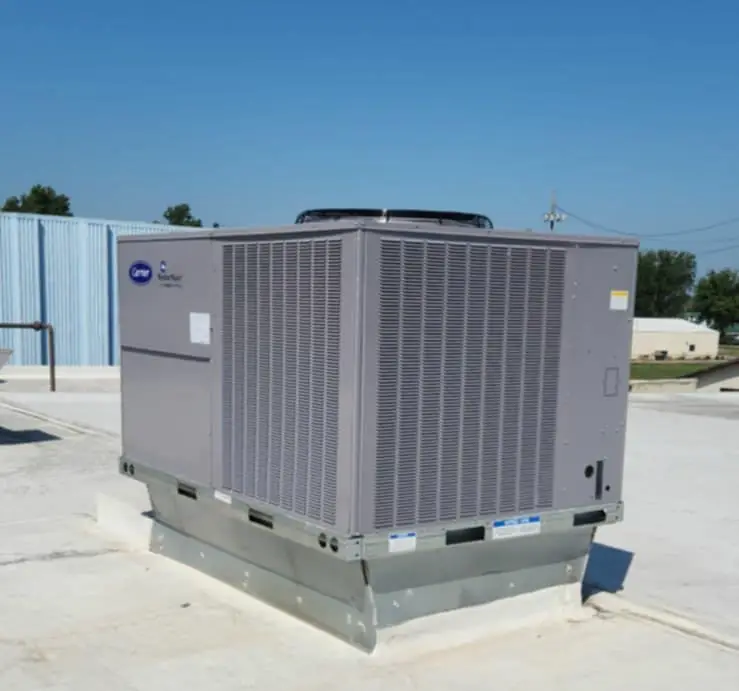
Rooftop air conditioning unit set on a commercial roof
Electrical first, then air and refrigerant
Because this shop started as an electrical business, a heating or cooling call starts the same way: checking the control wiring, the contactor, the capacitor and the igniter or flame sensor before touching anything on the airflow or refrigerant side. That order catches a lot of calls that would otherwise turn into a parts-swapping guessing game, and it's why electrical faults inside a furnace or a condenser are home ground here rather than an afterthought handed off to whoever's available.
Tuneups run in spring and fall, ahead of the extremes, and they're built to catch a marginal capacitor or a dirty flame sensor while it's still routine maintenance and not a Saturday call. A replacement, residential or commercial, gets sized to the building's actual heating and cooling load rather than just matched to whatever the old nameplate said, and free estimates cover both a tuneup visit and a full system replacement.
Commercial work follows the same order on a bigger scale: a rooftop unit gets checked electrically, then for airflow across the coil and refrigerant charge, before any compressor or motor gets called bad. New commercial installs get sized to the building rather than dropped in to match a curb that's already there, and the same crew that wires a house handles the unit on the roof above it.
Chapter 03
Filters, tuneups and the weekend line
A tuneup checks the electrical connections, the flame sensor or igniter, the refrigerant charge and the airflow together, as one system, rather than looking at just the piece that happens to be easiest to reach.
When something fails outside office hours, weekend emergency service runs around the clock through 618-723-2515, the same number as the shop, and it covers Noble along with the rest of Richland, Clay, Jasper and Wayne counties. Weekday office hours are Monday through Friday, 8:00 AM to 4:00 PM, and a call outside that window doesn't wait for Monday if the heat or the air conditioning is actually down.
Most of what turns into an emergency call was catchable earlier: a weak capacitor, a sensor that was already starting to soot up, a filter that went too long between changes. A tuneup twice a year, spring for cooling and fall for heating, is the cheapest way to keep the emergency line for actual emergencies.
Dan's Electric Shop & Electro Electric handles heating and air conditioning, residential and commercial, out of Noble. Free estimates, and the weekend emergency line is 618-723-2515.
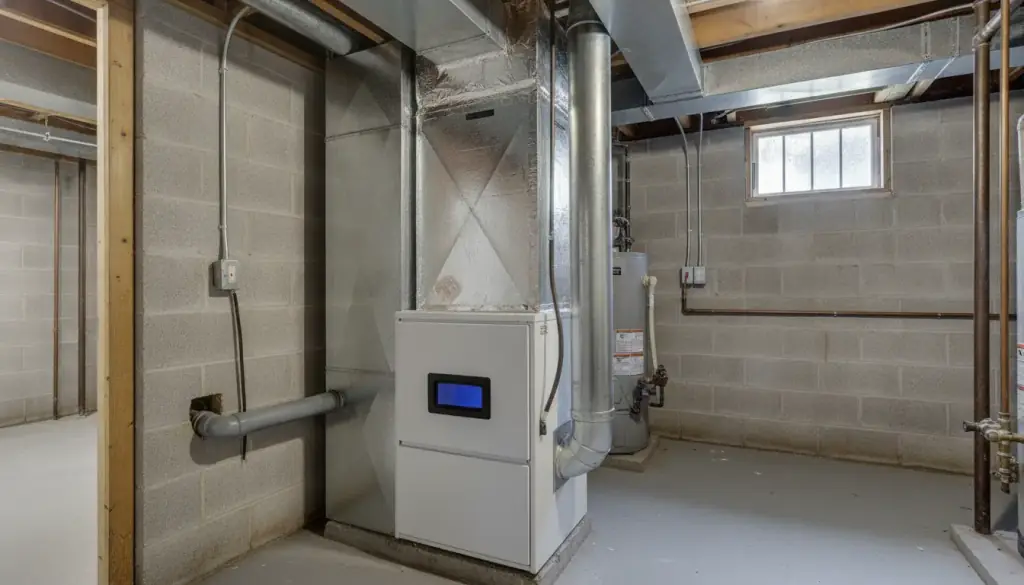
A furnace and its supply plenum in a basement mechanical room, illustrative of a typical residential install.