Ckt 3 · Farm systems and bins
Farm systems and grain bins
Feeders, disconnects and controls for bins, fans and farm buildings, wired to stand up to dust, damp and harvest loads.
Chapter 01
A bin site fails at the connections, not usually at the motors
Bin sites fail at the connections, not usually at the motors themselves. Aeration fans and augers run on long conductor pulls out to the edge of the yard, sitting in dust and damp for months at a stretch, and that's exactly where a connection corrodes or a disconnect starts sticking. A fan that won't start during a wet fall isn't broken, it's usually just lost the connection somewhere along that run.
Rodents chew through feeder wiring faster than most farms notice, and a disconnect left open to the weather corrodes from the inside long before the outside shows it. Then harvest comes and every motor on the site runs at once, fans, augers, the leg, and whatever weak connection was getting by on light duty the rest of the year finally trips. It's a familiar pattern on farms around Noble and across Richland, Clay, Jasper and Wayne counties.
A panel that's carried the same load fine for years can still trip the first week of harvest, because that's the one week every circuit on the site runs together instead of one at a time. That's not a sign something's wrong with the wiring, it's a sign the load was never actually checked against what harvest asks of it.
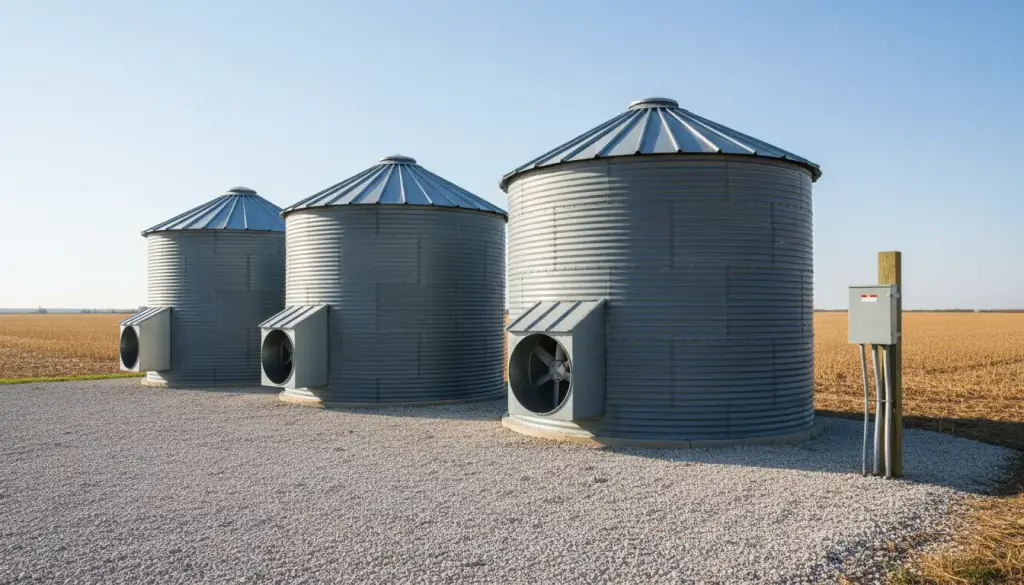
Three steel grain bins with aeration fans and a weatherproof disconnect on a post
Sizing the feeder to the load, not the other way around
Sizing starts with the motor loads, not a guess at what feeder was already there. Aeration fans, augers and leg motors each draw differently, and a feeder that's undersized will run hot for years before it fails outright. Weather-rated disconnects go in at the bin itself, so there's a clear shutoff right where the equipment is, not back at a panel across the yard.
Where livestock, equipment or plain farm traffic can reach it, wiring goes in conduit instead of hanging exposed, since exposed cable at a bin site gets snagged, chewed or run over eventually. Controls get placed where a hand can reach them without climbing over an auger or standing under a fan while it's running. A free estimate covers the whole site, house wiring, the shop and the bins together, not just one building at a time.
Outbuildings around the bins, a feed shed, a shop with a welder and an air compressor, get looked at the same way: what's actually drawing power, what it's sharing a circuit with, and whether the disconnect sits somewhere a person can reach fast if something goes wrong at the wrong hour.
Chapter 03
One call for the house, the shop and the bins
That means walking the disconnects, checking for corrosion and loose lugs, and confirming the panel can actually carry every motor running together, not just each one on its own. Every disconnect gets labeled clearly, so anyone on the farm can find the right shutoff without guessing.
It's the same crew wiring the house, the shop and the bins, so one call covers the whole operation instead of juggling separate electricians for each building. Free estimates apply across Richland, Clay, Jasper and Wayne counties, and if a fan or a leg goes down on a Saturday during harvest, 618-723-2515 runs the 24-hour weekend line.
Grain bins are usually a few miles out from the house, but they're wired by the same shop in Noble that handles everything else on the property. There's no separate call for a farm electrician versus a house electrician, just the same crew that already knows the site, the panel and the load.
Same crew, same shop at 152 E North Ave, Noble, since 1998.