Ckt 7 and 8 · Geothermal
Geothermal Heat Pump Service in Noble, IL
System analysis, repair and new installs for ground-loop heat pumps, electrical side and heating side together.
Chapter 01
When a ground-loop system starts losing ground
A ground-loop heat pump depends on steady flow and pressure in the buried loop, and when either one slips, the first sign is usually inside the house: a system that locks out and won't restart, or one that never quite catches up on a cold morning. A circulator pump losing capacity is one of the more common causes, and it sits right at the line between mechanical and electrical, not simple plumbing.
Auxiliary heat is built into most systems to cover exactly these moments, which is also what makes a failing loop easy to miss for a while. The house stays warm because the backup heat quietly picks up the slack, and the only real sign anything's wrong is a bill that's climbing and a system that never seems to reach setpoint on the primary heat pump alone.
None of that shows up as an obvious failure the way a dead furnace does. It shows up as a longer runtime, a lockout that clears itself and comes back a few days later, or a house across Noble and Richland, Clay, Jasper and Wayne counties that's technically staying warm on auxiliary heat while the ground-loop side of the system is quietly not doing its share.
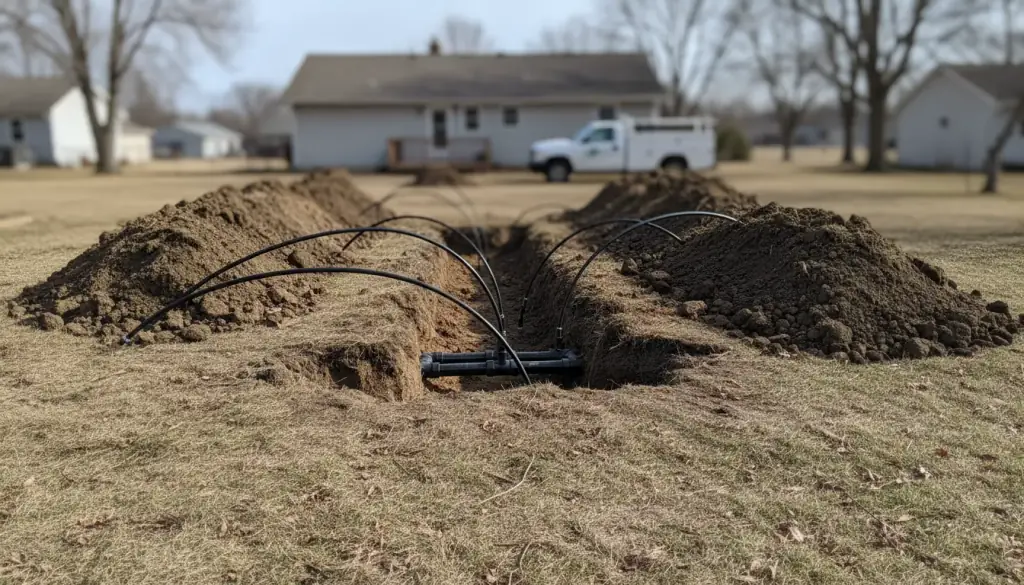
Ground loop pipe laid in an open trench in a rural yard
System analysis before parts
Before anything gets replaced, the system gets read: flow through the loop, temperatures across the heat pump, and the electrical draw the compressor is actually pulling. Those three numbers together point at whether the trouble is the loop itself, the circulator pump, the heat pump, or the wiring feeding it, instead of swapping parts one at a time and hoping one of them turns out to be the problem.
Repair covers both sides of the system, the heat pump and the pumping side that moves fluid through the buried loop, since a fix on one side rarely holds if the other's still working against it. On a new install, the loop gets planned first, sized to the building and to the ground it's going into, because a loop that's undersized or poorly placed limits everything connected to it for as long as the system runs.
Free estimates cover a system analysis, a repair visit or a full new install, and the analysis comes first either way. Guessing at a geothermal system usually means replacing the wrong part twice; reading the numbers before touching anything is what keeps a repair from turning into a second repair.
Chapter 03
What a healthy loop looks like, and when to call
A loop that's losing ground shows up as a wider swing than usual, a circulator running longer to move the same amount of flow, or a lockout that clears on its own and then comes back within a few days.
Electrical and HVAC under one roof matters here, because a geothermal system tends to fail on both sides at once about as often as not: a circulator pump losing capacity on the mechanical side, a control fault or a failing capacitor on the electrical side. Dan's Electric Shop & Electro Electric covers both out of Noble, on the same 618-723-2515 line used for weekend emergencies across Richland, Clay, Jasper and Wayne counties.
If the auxiliary heat seems to be doing more of the work than it used to, or the bill has crept up without an obvious reason, that is worth a call rather than waiting for a full lockout. Office hours are Monday through Friday, 8:00 AM to 4:00 PM.
Dan's Electric Shop & Electro Electric analyzes, repairs and installs ground-loop geothermal systems from Noble. Free estimates, and the weekend line is 618-723-2515.